



Blog
Smart charging and dynamic load management for EV networks

Imagine you are a Charge Point Operator (CPO), and you have just signed a site agreement with a retail park for 30 charge points. It is an ideal site: shoppers stay for two hours, the car park is full every weekend, and the landlord has already put the charge points in the marketing pack.
Then the grid survey comes back. The site has 100 kW of spare capacity. Thirty 22 kW alternating current (AC) chargers running at full power would need 660 kW.
This challenge does not have an easy solution. Upgrading the connection through the Distribution System Operator (DSO) typically takes a year or more and costs five or six figures, and the site earns nothing while you wait. CPOs already rank grid access as their main constraint. Without the upgrade, you can install four chargers and go back to the landlord to renegotiate.
Luckily, there is a third solution: software. Smart charging lets you install all thirty. It controls when and how fast each car charges, and its core function, dynamic load management, divides the available 100 kW in real time between the cars that are plugged in. On a busy Saturday with 20 cars connected, each receives about 5 kW, which adds roughly 60 km of range during a two-hour visit. On a quiet Tuesday morning, the few cars on site charge at full speed. For eMobility service providers (EMSPs) whose drivers use the site, that means 30 charge points to list in their apps instead of four.
This article explains how dynamic load management works at the Open Charge Point Protocol (OCPP) layer, when it becomes necessary for your EV business, and what to ask a software vendor about it before you buy the platform.
1. What smart charging actually means
Smart charging is a broad term that vendors tend to use loosely. At its simplest, it means any system that decides when a vehicle charges and how fast, rather than delivering maximum available power the moment a cable is connected. Everything below that marketing headline splits into three layers. Each layer solves different problems.
Static load management divides site capacity by a fixed rule. A 100 kW connection across 10 chargers gives each one a hard 10 kW cap, whether nine of them are idle or all ten are busy. It is simple, it is safe, and it underutilizes most of your capacity most of the time. One car charging alone at 3 AM still gets 10 kW while 90 kW sits unused.
Dynamic load management measures consumption at the site and reallocates continuously. The same 100 kW connection gives one overnight vehicle the full charger rating and throttles everyone proportionally when the car park fills at 6 PM. Capacity follows demand instead of a spreadsheet.
Grid-responsive charging takes the signal from outside the site. The DSO publishes available capacity or a price signal, and the platform shapes charging to match. This is where the Open Smart Charging Protocol (OSCP) and, further out, vehicle-to-grid (V2G) sit.
What operators actually care about is narrower than the taxonomy. They care about not running out of capacity mid-session, not paying demand charges for a peak they did not need, and not commissioning a grid upgrade every time they add a site. Electric vehicle smart charging is worth the configuration effort when it moves one of those three numbers, and most smart charging solutions on the market are sold on the first while quietly costing you on the second.
2. Dynamic load management in detail
You will see the same mechanism sold as dynamic load management, dynamic load balancing, or dynamic load control. The labels are interchangeable. What matters is whether the system reads live power draw and acts on it, or just enforces a fixed ceiling.
Dynamic load management in EV charging works on a loop. A meter at the site's connection point reports actual consumption, including whatever the building itself is drawing. The platform compares that against the connection's rated limit, subtracts a safety headroom, and divides the remainder across active charging sessions. When a car finishes or a new one plugs in, the split is recalculated and pushed back out to the chargers. On a well-implemented system, this happens in seconds.
The building load is the part operators underestimate. Heating, ventilation, and air conditioning, plus refrigeration and lighting, can swing a retail site's baseline by 30 kW across a day. Static allocation has to assume the worst case permanently, which means sizing your charging capacity against the site's peak building draw even at 2 AM when the building is dark. Dynamic load balancing across the EV chargers on site takes that headroom back, and on mixed-use sites the recovered capacity is often larger than the charging load itself.
The allocation strategy sits on top of the loop, and it is a real choice. Splitting power evenly across every active session is the most predictable option and the easiest to explain to a driver or a site host. Weighting by departure time gets the van leaving at 5 AM finished first. Protecting a direct current (DC) rapid charger, which drivers pay a premium for and expect to be fast, means the AC chargers absorb the throttling instead. Each approach has its use cases, which is why the strategy should be selectable per site rather than fixed in the platform.
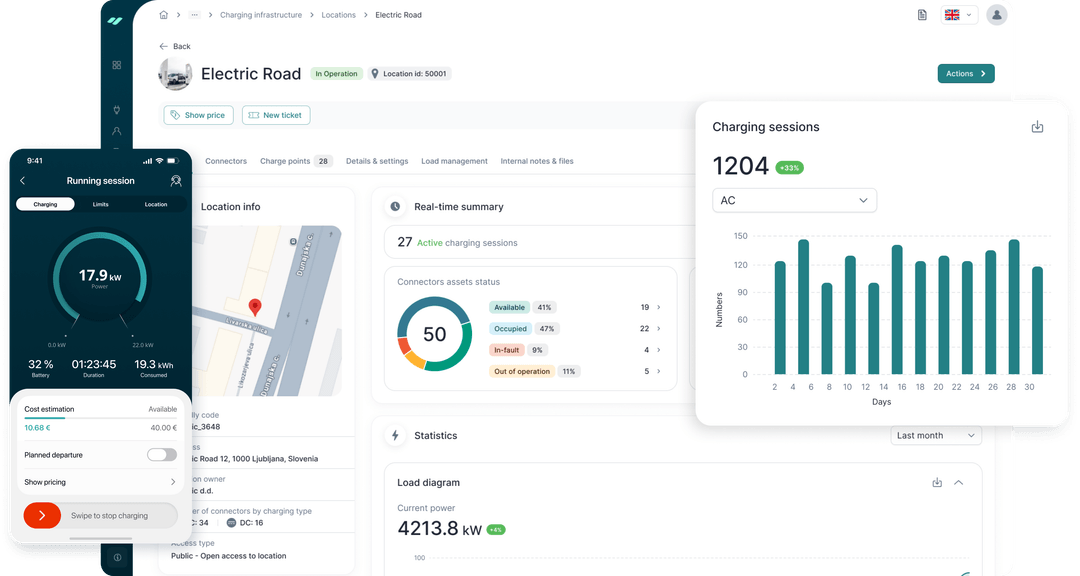
Ocean's TIDE load management runs on AC in production today, with the DC extension in delivery for 2026. It ships several strategies per location, including "as fast as possible", "as slow as possible", and an Equal Share mode added in July 2026 that splits available power evenly across every active session regardless of arrival time, departure time, or vehicle type. The mechanics are documented on our load management feature page, with the deeper energy-management picture explained on the load and energy management page.
Let's take a look at how this looks in practice. Petrol, one of Slovenia's largest energy and mobility providers, ran a load management field test at its site: eight EVs connected and disconnected across a cluster of high-power chargers, against scenarios Petrol wrote, with Ocean's load management specialist on site. The exercise successfully confirmed how the platform distributes power across active vehicles under real conditions rather than in a lab. Ocean manages around 33,000 charge points and delivered over 178 GWh in 2025. Those numbers show scale. A field test shows whether power limits reach the chargers and hold as cars come and go, and that comes down to OCPP.
3. Why OCPP is the enabler, and what that means for platform selection
Load management is a control loop first: software issuing power limits to physical hardware, continuously, all day. It has to reach every charger on the site, quickly and reliably, and hold authority over what each one draws. That makes it an OCPP problem that happens to have a dashboard on top.
The mechanism in OCPP 1.6 is SetChargingProfile. The platform sends each charger a profile describing the power limit it must respect and for how long, then revises it as conditions change. ChangeAvailability handles the coarser case of taking a connector in or out of service. OCPP 1.6 JSON carries all of this in production today across the industry, which is why load management is a solved problem on 1.6 rather than something you wait for a newer version to deliver.
The version picture past 1.6 is worth understanding before a vendor uses it on you. OCPP 2.0.1 adds finer-grained scheduling and closer ISO 15118 integration, and the Open Charge Alliance has since published OCPP 2.1, out since January 2025 and carrying a dedicated bidirectional charging block. Adoption runs on each vendor's own timeline, Ocean's included: its 2.0.1 stack is in delivery on a rebuilt WebSocket server, with full launch targeted for the start of 2027. None of that changes what you can do about load management this year, which is a lot, on 1.6.
Here is the distinction that decides platform selection: whether load management is native to the platform that owns the OCPP connection or bolted on beside it.
A third-party load management overlay does not have its own channel to the chargers. It has to issue commands through the same OCPP connection your charge point management system (CPMS) already owns, which means an extra hop, added latency in a loop that needs to react in seconds, and a genuine ambiguity about which system holds authority over a connector. When both systems believe they are in charge and issue conflicting profiles, the outcomes range from chargers throttled for no reason to a site that exceeds its limit and trips the main breaker. Neither is a theoretical risk, and both are hard to diagnose after the fact because the two systems keep separate logs.
Ask a vendor a direct question: does load management run inside the platform that speaks OCPP to my chargers, or is it a separate product that talks through it? Then ask which charger models it has controlled in production, because a profile that one manufacturer honors precisely and another rounds to the nearest 6 A is the kind of dialect problem that only shows up on a live site. That failure mode, and the rest of the OCPP reality vendors often leave out, is covered in OCPP in practice: what CPMS vendors don't tell you.
For a deeper read on how OCPP depth shapes what a platform can actually deliver, the smart charging gap in most CPMS platforms goes through it version by version.
4. Use cases where load management stops being optional
Workplace sites with fixed building capacity. An office building has whatever spare capacity the original design left, and it is usually modest. Employee charging is also the most forgiving load in the category, because cars sit for eight hours and almost nobody needs a full charge in two. This is the easiest place to deploy dynamic load management and the hardest place to justify a grid upgrade.
Fleet depots charging overnight. A depot's requirement is not speed; it is completion: every vehicle ready by its departure time. That converts directly into a scheduling problem, where the platform spreads charging across the whole overnight window, keeps the site inside its limit, and shifts load into cheaper tariff periods. Depots that skip this end up sizing their connection for simultaneous full-rate charging they never actually need.
Mixed AC and DC installations. A site running 150 kW DC rapid chargers alongside AC destination chargers has two very different load profiles competing for one connection. DC draws hard and briefly. AC draws modestly for hours. Managing them as one pool, with priority rules that protect the paid-for rapid session, needs a platform that handles both natively rather than one that treats DC as an exception.
Multi-tenant sites. Retail parks and shopping centers where several sub-operators run chargers under one connection have a commercial problem on top of the technical one: capacity has to be allocated fairly, and each tenant needs to see what they were allocated and what they drew. Proportional sharing without per-tenant visibility turns into a monthly argument.
High-density urban destination charging. City-center sites rarely have spare grid capacity and almost never have room for a substation. Load management is frequently the only way the site gets built at all.
5. Grid integration: OSCP and beyond
OSCP extends the control loop past your own meter. Instead of the platform working only from what it measures at the connection point, the DSO or site owner publishes a 24-hour forecast of the capacity available to that site, and the platform plans charging against it.
That matters in two situations. The first is high-density deployment, where the local network is genuinely constrained, and a DSO will grant a larger connection only if the operator can demonstrate control over the load. The second is a utility partnership, where flexibility has commercial value and an operator who can shift load on request has something to sell.
Read the protocol's status honestly, though, because vendors rarely will. OSCP 2.0 dates from 2020, and the Open Charge Alliance states plainly that OSCP is no longer actively managed or developed within the organization. It remains the mechanism where DSO capacity-forecast programs exist, and support for it is a fair thing to require, but treat it as a stable old standard rather than the frontier. The grid-flexibility work with momentum behind it is happening in national flexibility market schemes and in OCPP itself.
That is also where V2G now sits. OCPP 2.1 added a functional block for bidirectional charging alongside ISO 15118-20 support, so the standards groundwork exists rather than being hypothetical. What does not yet exist at scale is the vehicle fleet, the DSO programs, and the settlement rules to make it pay in most European markets. Design for it by choosing a platform with real smart charging depth and keep V2G revenue as upside rather than a line in the business case.
6. What to demand from your smart charging software
Eight questions separate platforms that manage load from platforms that display it.
- Is load management native or an add-on? Native means it runs inside the system that holds the OCPP connection. Anything else adds a hop and an authority conflict.
- Which charger brands has it controlled in production? Ask for models, not a count. Charging profile handling varies by manufacturer and firmware version, and testing is not production.
- AC and DC? Plenty of platforms manage AC competently and treat DC as out of scope. If your roadmap includes rapid charging, ask now.
- Does it read the building load? A system that only meters the chargers cannot use the capacity your building frees up overnight, which is often the largest single source of headroom on a mixed-use site.
- Can you choose the allocation strategy per site? Equal shares, departure times, vehicle classes, protected rapid sessions. One hard-coded strategy is a blunt instrument across a mixed portfolio.
- Does it support OSCP? Only relevant if a DSO in your markets runs a capacity-forecast program, but if one does, the alternative is planning against a number nobody is sending you. Ask which deployments use it rather than whether the box is ticked.
- Can you see what it did? Load curves per site, per connector, showing allocated versus delivered power. Without that reporting, you cannot prove to a landlord or a DSO that the site stayed inside its limit, and you cannot tell an underpowered site from a badly configured one.
- What does it cost when the site is busy? Platforms that take a percentage of session value charge you most at exactly the sites where load management is doing the most work. Per-connector and module pricing, which is Ocean's model, does not move with throughput.
Get the answers in writing before signing, because load management is the capability most often demonstrated on a vendor's reference site and least often validated on yours. It also belongs in the service level agreement (SLA), not just the feature list: badly allocated power shows up as failed and abandoned sessions, so the number to hold a vendor to is charging success rate.
7. Frequently asked questions
What is smart charging?
Smart charging is any system that controls when an EV charges and at what power, rather than delivering full available power the moment the cable is connected. In a commercial context, it usually means the charging platform is managing site capacity, energy cost, or a grid signal, instead of leaving each charger to draw whatever it can.
What is the difference between static and dynamic load management?
Static load management applies a fixed power cap per charger, calculated once from the site's worst case. Dynamic load management measures actual consumption in real time and reallocates continuously, so idle capacity goes to the vehicles that are charging. Static is simpler. Dynamic commonly supports several times more chargers on the same connection, though the multiple depends entirely on how much your sessions overlap, so model it against your own site's usage rather than a vendor's headline figure.
How does dynamic load management work in EV charging?
It runs as a continuous loop. A meter at the site's grid connection reports what the whole site is drawing, including the building. The platform subtracts that from the connection's rated limit, keeps a safety margin, and divides what is left across the active charging sessions, sending each charger a power limit over OCPP. Every time a vehicle plugs in or finishes, the split is recalculated and pushed out again, in seconds on a well-implemented system.
Does dynamic load management slow down charging?
At a busy site, yes, by design: power is shared instead of the first arrivals taking everything. In practice, most drivers never notice, because sessions are usually much longer than the time needed to add the range a driver actually wants. On a depot with scheduling rules, vehicles still finish by their departure time.
Does smart charging work with mixed charger brands?
It should, if it is built on hardware-agnostic OCPP. The caveat is that manufacturers implement charging profiles with varying precision, so ask which specific models a vendor has controlled in live networks rather than which ones they claim to support.
Do I need OCPP 2.0.1 for smart charging?
No. OCPP 1.6 JSON carries production smart charging today through SetChargingProfile, and that is what the installed base runs on. OCPP 2.0.1 adds finer-grained scheduling and closer ISO 15118 integration, and the Open Charge Alliance has since released OCPP 2.1 with a bidirectional charging block. Vendors are adopting both on their own timelines, so ask where a specific platform is rather than assuming a market-wide date.
Can load management replace a grid connection upgrade?
Load management can often replace grid connection upgrades. That is usually where the business case comes from. A site that cannot support every charger at full power simultaneously can still support them all if consumption is managed, since simultaneous full-rate charging is rare. It does not help when your genuine, sustained demand exceeds the connection, at which point the upgrade is real.
8. The bottom line
Smart charging is usually sold as an energy-efficiency feature. For an operator, it is a deployment feature: it decides how many chargers you can put on a connection, which sites are viable, and how many grid upgrades you have to fund before the network is finished.
The capability lives or dies at the OCPP layer, which is why it belongs to the platform holding those connections rather than to a product sitting alongside it. Ask where it runs, which chargers it has controlled in production, and whether you can see what it did afterward.
If you are further along and weighing how the platform decision plays out commercially, how your CPMS choice becomes a competitive advantage covers that ground. The question underneath it is what your platform's OCPP layer can actually do, version by version and vendor by vendor. That is the OCPP vendor gap analysis. Read it before your next vendor call.
Discover more Blogs








Our trusted partners


