
Blog
What is a Charge Point Management System (CPMS)?
A charge point management system (CPMS) isn't just software. It's the backbone for your entire electric vehicle charging business.

(And why your choice of CPMS matters more than you think)
Most charge point operators choose theirCPMS in the same way they choose their first chargers: looking at what's available and affordable. Six months later, they regret it.
The free CPMS bundled with your charger vendor seems like a no-brainer until you need to add a different brand ofhardware. The basic monitoring platform looks sufficient until you're managing50 stations and can't figure out why energy costs are spiking.
A charge point management system (CPMS) isn't just software. It's the backbone for your entire electric vehicle charging business.
This guide explains:
- What a CPMS actually does,
- How it fits into the charging infrastructure ecosystem,
- The common mistakes CPOs must avoid when choosing their CPMS,
- The benefits of a good CPMS, and
- What to look for before you're locked into a platform that can't grow with you.
What does a Charge PointManagement System (CPMS) actually do?
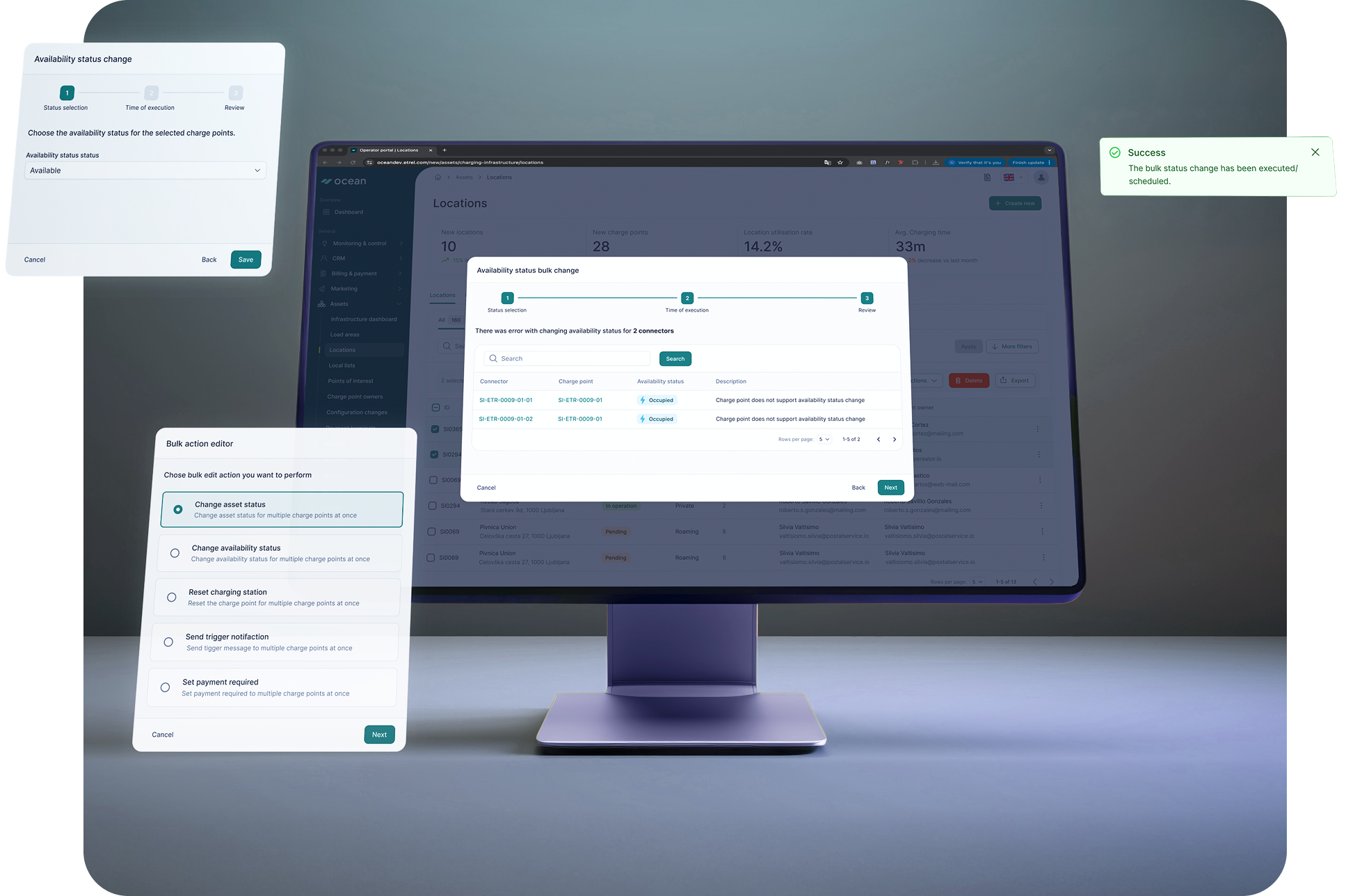
A Charge Point Management System (CPMS) is the software platform that sits between your charging stations and everything else: drivers, payment processors, energy management systems, and businessoperations. A CPMS has 4 fundamental jobs:
- Charger connectivity: Maintains communication with every charging station via protocols like OCPP (Open Charge Point Protocol).
- Real-time monitoring: Tracks the status, energy consumption, errors, and session data for every EV charger.
- Billing and payment: Manages user authentication, pricing models, payment processing via credit cards or mobile apps, and invoicing. Bonus: for regulated markets, it is compliant with the mandated regulation, like AFIR.
- Roaming Integration: Connects your network to external platforms like Hubject so drivers from other networks can use your EV chargers.
Without CPMS software, you're managing each charger manually. That’s fine for 5 chargers, challenging at 50, impossible at500.
More importantly, you're missing the operational intelligence that lets you optimize energy costs and prevent downtime.
How CPMS fits into the electric vehicle charging ecosystem
The EV charging infrastructure stack has five layers: charging hardware, communication protocol (OCPP[1] ),CPMS backend, driver-facing apps, and integration layers (payment gateways, energy management, fleet telematics, roaming networks).
Think of the CPMS as the operating systemf or your charging network. Just like your phone's OS sits between hardware andapps, CPMS is part of the EV backend that sits between chargers and everything that depends on them: billing systems, energy optimization, driver apps, and analytics.
For charge point operators (CPOs), this matters because the CPMS you choose determines what's possible at every otherlayer. A CPMS locked to one charger brand limits hardware options. One withoute nergy management APIs can't integrate with demand response programs. The charging stations last 7-10 years, but the CPMS is infrastructure you're building a business on top of.
To avoid picking the wrong CPMS for your EV business, let’s look at the common pitfalls CPOs make when selecting their Charge Point Management Systems.

Three mistakes CPOs make when choosing CPMS
Mistake #1: Accepting vendor lock-in with proprietary protocols
Your charger vendor offers a"free" CPMS with hardware. You're starting out, so free sounds smart. Six months later, you want to add DC fast chargers from a different manufacturer, and they won't connect. Your CPMS only speaks the charger vendor's proprietary protocol, not true hardware-agnostic OCPP.
The cost:You're now locked into one hardware vendor for your entire network lifecycle, even when their pricing isn't competitive, or their product doesn't fit your use case. The alternative - migrating to a new CPMS - means reconfiguring every charger, migrating user data, and risking revenue loss during the transition.
What to do instead: Choose a hardware-agnostic OCPP platform from day one. Verify it's been tested with multiple charger brands (not just "OCPP-compliant"in marketing materials). Ask vendors for a compatibility list showing real deployments with 3+ different hardware manufacturers.
Mistake #2: Ignoring performance requirements for real-time operations
You evaluate CPMS platforms based on feature checklists:
✔️ monitors status,
✔️ processes payments,
✔️ sends receipts.
But you don't test performance under load.Twelve months later, at 50 charging stations, your dashboard takes 8 seconds to load. Remote commands to restart a faulted charger time out. Status updates lag by 2 minutes, making real-time troubleshooting impossible.
The cost:Slow systems don't just frustrate operators. They kill uptime. When a chargerf aults at 2 AM and your CPMS can't execute a remote reset in under 60 seconds, that station stays offline until a technician arrives 48 hours later. When you scale, slow = broken.
What to do instead: Require vendors to demonstrate performance benchmarks: <1,000ms operator dashboard response times, <15-second event visibility (plug-in,faults), and proof of handling 8,000+ concurrent charging sessions. Commodity platforms can't meet these thresholds. Utility-grade systems can.
Mistake #3: Underestimating the cost of manual operations at scale
You assume that basic monitoring and alerting are enough. When a charger goes offline, you get an email. When aconnector locks, you dispatch a technician. This works fine for 10 chargers. At100+ chargers, you're drowning in support tickets and truck-roll costs.
The cost:Operations and maintenance (O&M) become your biggest expense. A single truck roll costs €250. Multiply that by dozens of "Connector Lock"faults per month that could have been fixed with an automated remote reset, and you're hemorrhaging profit. Manual operations don't scale.
What to do instead: Choose a CPMS with automated "self-healing" logic:remote fault recovery that automatically resets chargers based on OCPP error codes, ghost session detection that terminates sessions where status shows"active" but power is zero for 15+ minutes, and automated offline CDRsync when chargers reconnect after network failures.
Don’t commit to a 5-year CPMS contract based on “gut feeling”. Download our guide to CPMS procurement to avoid the common mistakes CPOs make when buying their next Charge Point Management System.[2]
But a good CPMS doesn’t just help you avoid common mistakes. It unlocks new ways to grow your EV business.
What are the benefits of a CPMS?
A well-chosen CPMS delivers measurable, operational and financial benefits. Here's what changes when you implement theright platform:
Benefit #1: [3] [4] [5] [6] 20-40%energy cost reduction through smart charging
Energy usage costs become your largest operating expense at scale. A CPMS with smart charging capabilities (including load balancing, demand response, and time-of-use optimization) cuts these costs dramatically.
Load balancing prevents expensive grid upgrades by dynamically distributing power across multiple charging stations.If your site has 100 kW grid capacity and ten cars plug in, the CPMS throttle seach to 10 kW instead of overloading circuits.
Demand response lets you participate inutility programs. During peak energy demand, the utility compensates you for reducing consumption. Your CPMS automatically throttles charging and resumes when demand drops.
Time-of-use optimization shifts workplaceor fleet charging to off-peak hours when electricity is 50-70% cheaper. For a50-charger network dispensing 500MWh annually, this optimization can save more than €50,000 per year.
Benefit #2: Scalability without platform migration
A utility-grade CPMS handles 8,000+concurrent charging sessions, 55,000+ charge points, and 200,000+ registered users without performance degradation. This means you can scale from 10 to1,000 chargers on the same platform. No forced migration, no data loss, no operational disruption.
Why this matters: Migrating CPMS mid-growth is expensive and risky. You're reconfiguring every charger, migrating useraccounts and payment credentials, recreating pricing rules, and reintegrating third-party systems. The typical migration takes 6-12 months. Choose a platform that scales with you from the start.
Benefit #3: 100% billing accuracy and revenue integrity
A CPMS is your financial system of record.Every charging session must be captured accurately, even during network failures or charger offline periods. Resilient platforms automatically reconcile transaction records (CDRs) when chargers reconnect after offline periods. With zero revenue leakage.
For regulated markets: AFIR-compliant CPMS platforms maintain <15-second latency for status updates pushed to NationalAccess Points (NAPs), ensuring regulatory compliance and eliminating"phantom chargers" that appear available to drivers but aren't.
Benefit #4: Roaming network revenue without operational complexity
A charging network invisible to drivers outside your app leaves money on the table. CPMS platforms with roaming support(OCPI, OICP) connect you to networks like Hubject, Gireve, PlugSurfing andothers. This puts you in front of new EV drivers who discover and pay for charging at your EV charging stations automatically.
The benefit: Roaming increases charger utilization without marketing spend. But it introduces complexity: currency conversion, settlement across platforms, and reconciliation.
A capable CPMS handles this automatically, expanding your addressable market without expanding your operations team and without changing your EV charging infrastructure.
Benefit #5: Hardware flexibility through true OCPP interoperability
A hardware-agnostic OCPP platform lets you choose the best charger for each use case without platform constraints. Need DC fast charging? Add it. Want to pilot wireless charging? Connect it. Do new sites require a specific form factor? Deploy it.
The strategic value: This isn't just about theoretical flexibility. It's negotiating leverage with hardware vendors. When you're not locked in, vendors compete on price and performance. When you are locked in, you pay whatever they charge.
The bottom line: Your CPMS is the backbone of your EV business
CPMS isn't just the software you use. It's the backbone you build on. It determines what chargers you can deploy, how youm anage energy usage costs, whether you can join roaming networks, how easily you integrate with external systems, and whether you can scale from 100 to1,000 chargers without migrating.
The wrong CPMS choice won't kill your business immediately. But it'll slow your growth drastically.
Before you scale your charging network, understand what separates basic CPMS from platforms built for growth.
Download the Strategic CPMS Procurement: A Playbook for the Operational Era to learn what to look for before you commit to a platform.
Discover more Blogs




Our trusted partners